Student Conduct Process Flow Chart
This page presents flowcharts of the student conduct process, showing how cases are reviewed and the potential pathways, including advisory notices, alternative or administrative resolutions, formal hearings, and appeals.
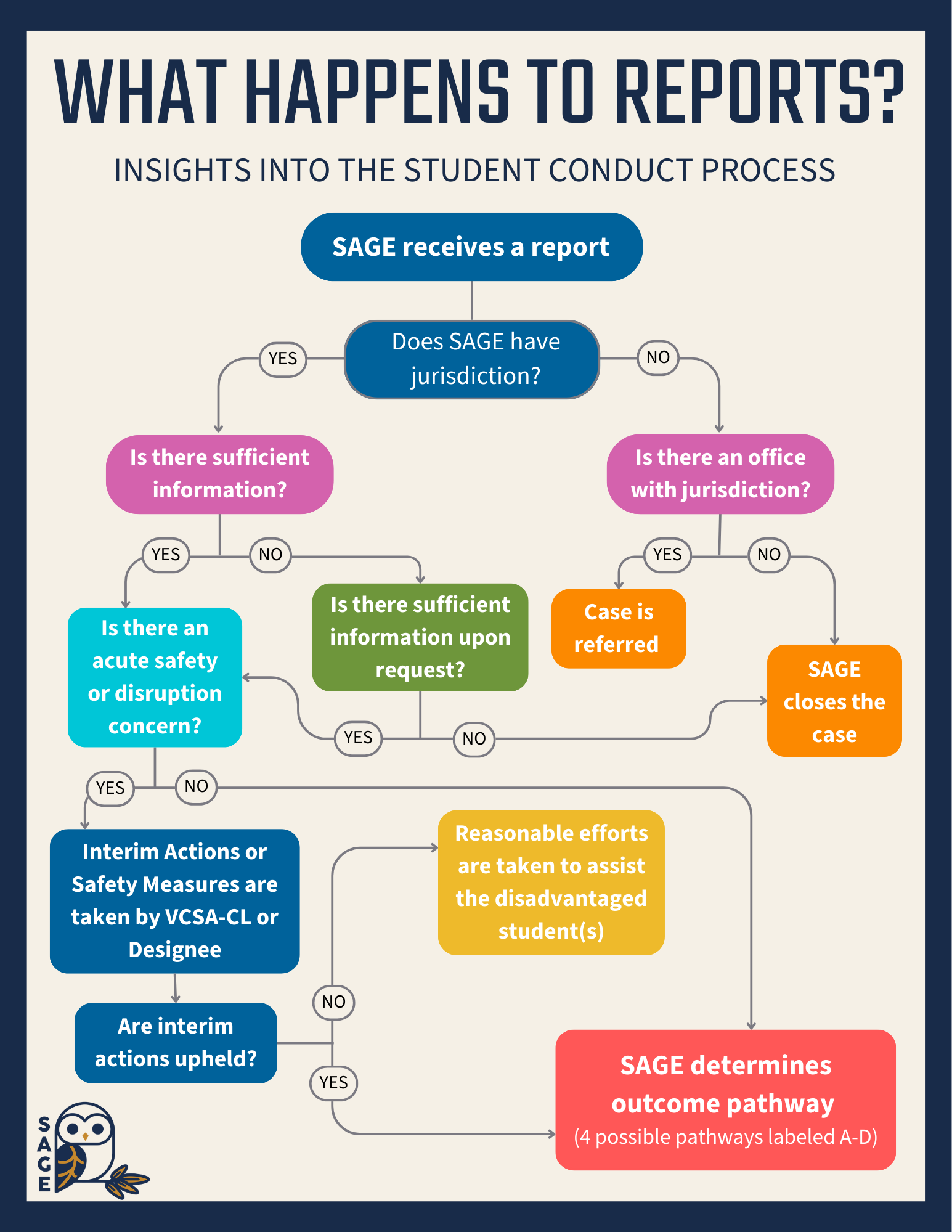
Flowchart 1 outlines the process from when a report is received by SAGE to determining the next steps.
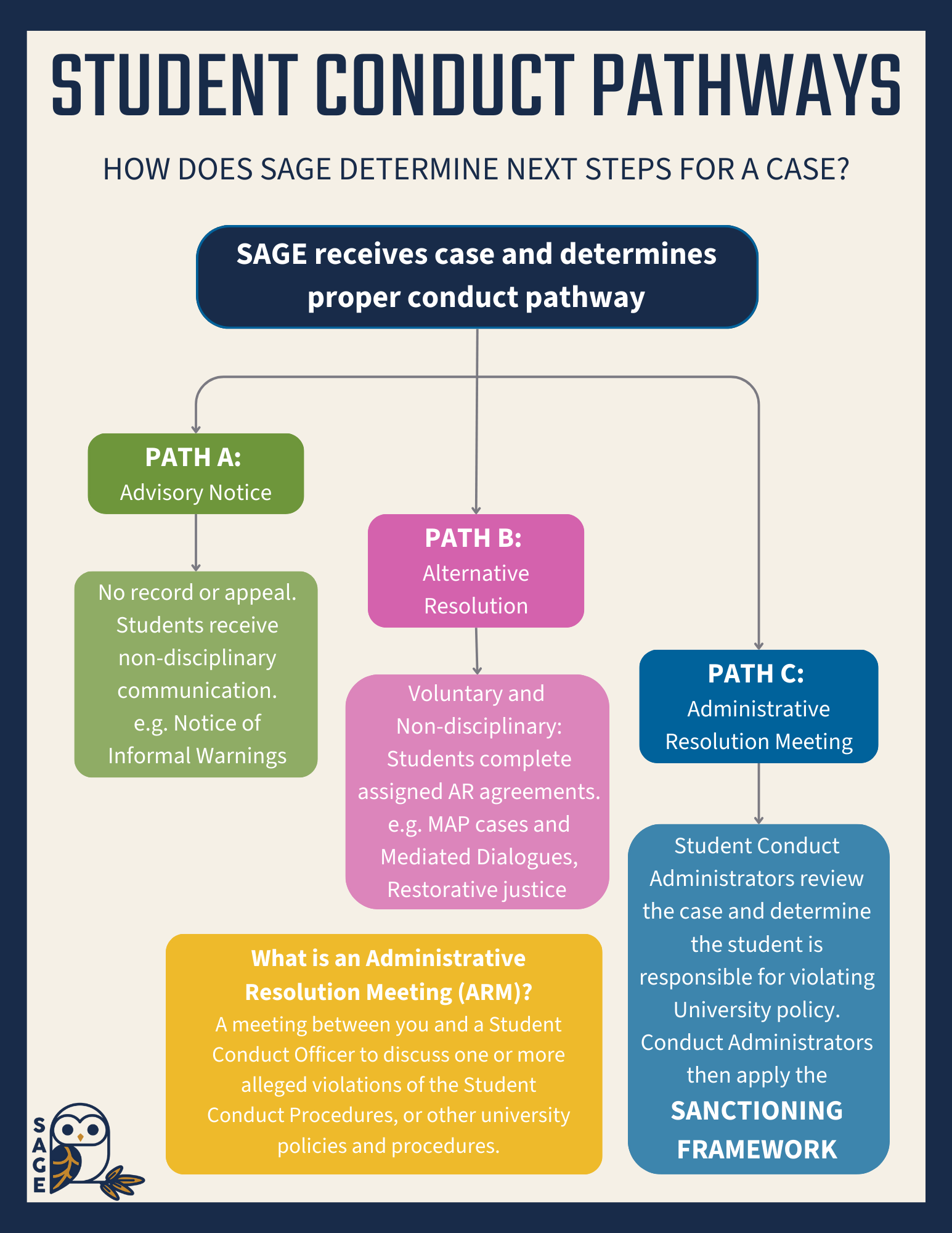
Flowchart 2 shows the potential pathways of the conduct process. You can read more about the different pathways in the drawers below.
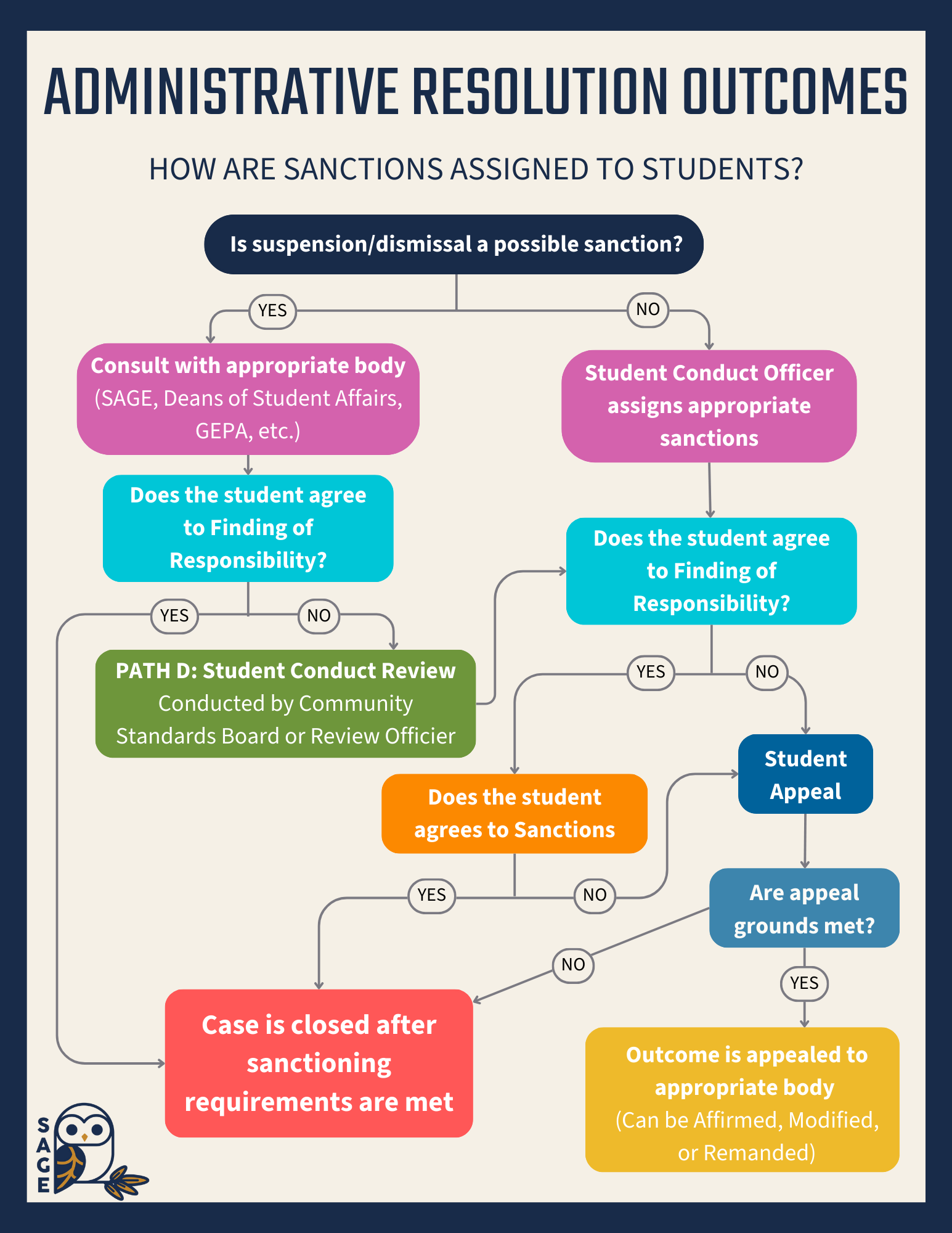
Flowchart 3 shows the possible sanction pathways depending on the outcome of the Administrative Resolution Meeting, including the Appeals process.
For more information, please visit our Policies, Process and Procedures page.
To view or download the flowcharts as a PDF, please select this link.
Once SAGE receives a report, it is reviewed to determine the next steps. Below are descriptions of the possible pathways shown in the chart above.
If the Student Conduct Administrator’s determination is that the student is not responsible for violating University policy, or if there is insufficient information to make a determination, Student Conduct will notify the student accordingly and may issue an Advisory Notice or take no further action. An Advisory Notice is not eligible to appeal.
At any point during the process, Student Conduct may offer an Alternative Resolution option (e.g., mediated dialogue, restorative justice, educational agreement), subject to the following conditions:
- The student does not dispute the facts relevant to whether the policy violation occurred, and/or acknowledges responsibility;
- All involved parties who are willing to participate in any process, including any impacted individuals, consent in writing to participate. The Student Conduct Administrator will determine who is an “involved party.'
Alternative Resolution is not eligible to appeal.
If the Student Conduct Administrator has determined that the student is responsible for violating University policy, Student Conduct will determine what sanction and/or University action should be taken and will issue an Administrative Resolution
- If the student accepts the Administrative Resolution, the outcome is final, and no hearing or appeal will follow
- If the student does not accept the Administrative Resolution and:
- The Administrative Resolution does not include suspension or dismissal, the student may elect to appeal the Administrative Resolution finding(s) and/or sanction(s) within 10 business days of the issuance of the Administrative Resolution, via written communication to the designated appeal body identified in campus implementing regulations. The student may appeal on the grounds described in this section. The appeal should identify the reason(s) why the student is challenging the Administrative Resolution under one or more of the following:
- new information not available at the time of the investigation, the absence of which can be shown to have materially affected the outcome;
- there was procedural error in the process that materially affected the outcome;
- the proposed sanction is disproportionate given the findings of fact.
- The Administrative Resolution includes suspension or dismissal, the student may elect to contest Student Conduct’s determination of responsibility by proceeding to a Formal Hearing (see Section IV.D.
below). Within 5 business days of the issuance of the Administrative Resolution, the student must indicate via written communication to Student Conduct or their designee if they wish to contest Student Conduct’s determination of responsibility.
- If the Administrative Resolution includes suspension or dismissal, and the student accepts responsibility for the policy violation, but wishes to appeal the sanction (suspension or dismissal), they may submit a written appeal on only one ground, that the proposed sanction is disproportionate given the findings of fact. Within 5 business days of the issuance of the Administrative Resolution, the student must indicate via written communication to Student Conduct or their designee if they wish to accept responsibility for the policy violation, but appeal the sanction. The student will have an additional 5 business days to submit their written appeal to Student Conduct or their designee, identifying the reason(s) why the student is challenging the proposed sanction.
- When an appeal is permitted under the procedures outlined above, the implementation of sanctions will be deferred pending the outcome of the appeal. Student Conduct may submit a written response to the designated appeal body within 7 business days of receiving a copy of the appeal. Absent good cause for an extension, the appeal body will issue a written decision to the student within 20 business days of receiving the appeal and all related documents. The decision of the appeal body is final.
- Following the issuance of the Administrative Resolution, if the student does not respond within the timelines listed above, the outcome is final, and no hearing or appeal will follow.
When the outcome of the Administrative Resolution includes suspension or dismissal, and the student has contested Student Conduct’s determination of responsibility, the case will proceed to a formal hearing called a Student Conduct Review. Campus implementing regulations shall provide the following minimum procedural standards to assure the student a fair hearing:
- Written notice (via the Notice of Allegations or subsequent Administrative Resolution), including a brief statement of the factual basis of the charges, the University policies or campus regulations allegedly violated, and the time and place of the hearing, no less than 10 business days before the hearing;
- The opportunity for a fair hearing where the University will bear the burden of proof, and at which the student will have the opportunity to present documents and witnesses and to question witnesses presented by the University;
- A record of the hearing; a written decision based upon the preponderance of evidence, that includes a summary of the relevant facts and a conclusion for each alleged policy violation, sanctions, if applicable, and information about the right to appeal, within 20 business days of the hearing.
- An appeals process that requires a student dissatisfied with the written decision and who wishes to challenge it to submit an appeal in writing to the designated appeal body within 10 business days of the hearing outcome notice. The student may appeal via written communication to the designated appeal body identified in campus implementing regulations. The student may appeal on the grounds described in this section. The appeal should identify the reason(s) why the student is challenging the
hearing body decision under one or more of the following:
- new information not available at the time of the hearing, the absence of which can be shown to have materially affected the outcome;
- there was procedural error in the process that materially affected the outcome;
- the proposed sanction is disproportionate given the findings of fact.
When an appeal is permitted under the procedures outlined above, the implementation of sanctions will be deferred pending the outcome of the appeal. Student Conduct may submit a written response to the designated appeal body within 7 business days of receiving a copy of the appeal. Absent good cause for an extension, the appeal body will issue a written decision to the student within 20 business days of receiving the appeal and all related documents. Once issued, the decision of the appeal body is final.